Screw feeders
Loss In Weight Feeders
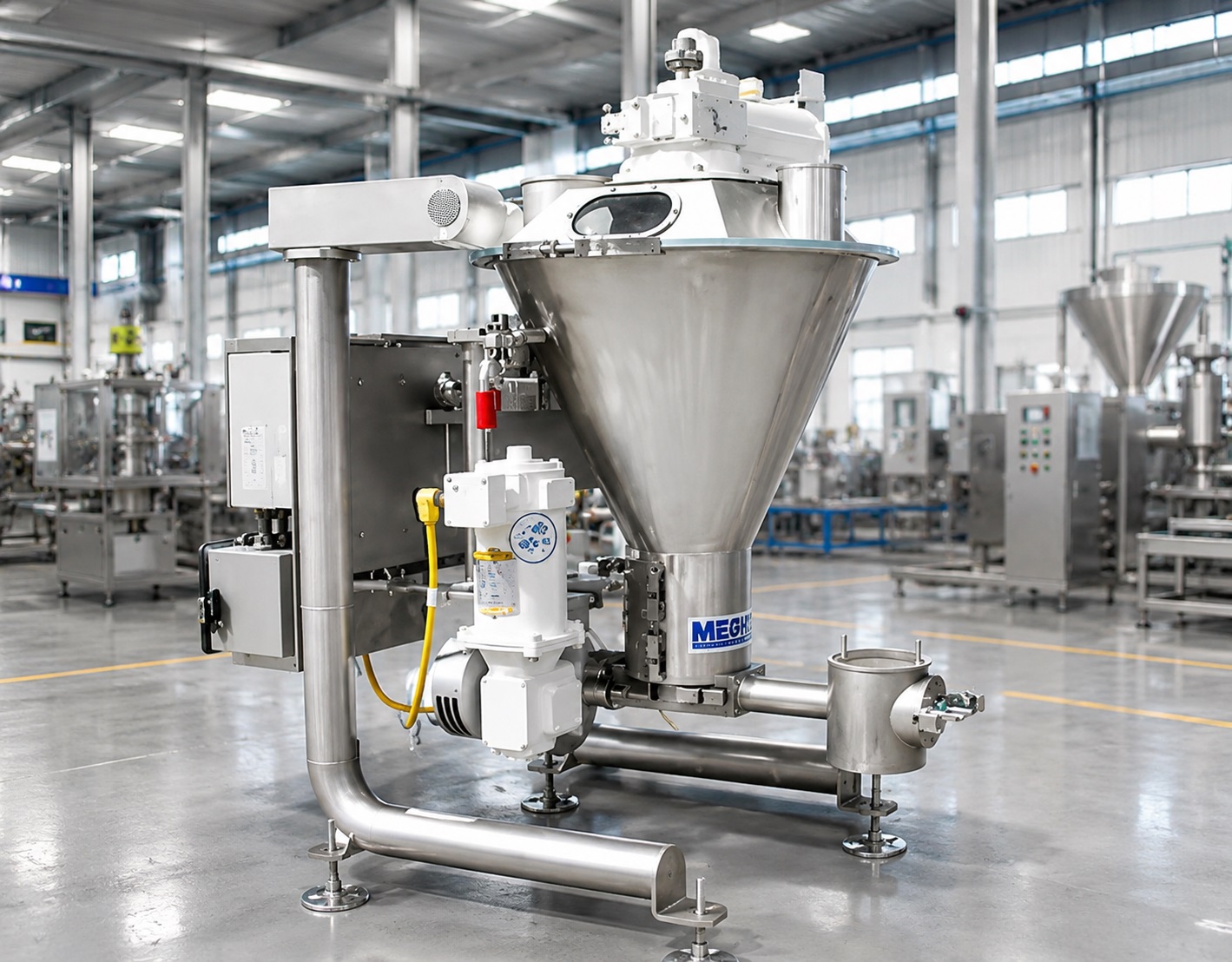
Loss in Weight Feeding Systems
Raman Systems Pvt. Ltd. Loss in Weight Feeding Systems offer versatile solutions suitable for small to medium feeding ranges, ensuring precision even under optimal ambient conditions. These feeders are highly adaptable, capable of handling bulk solids efficiently, and find applications across various continuous processes, including accurate feeding into devices. They are extensively utilized in industries such as food and laboratories, utilizing tailored storage containers and feeding devices. The design spectrum ranges from compact constructions to modular concepts, catering to diverse usage scenarios.
The principle behind Loss in Weight Feeders involves monitoring the decrease in system weight as material is fed through. By controlling the feeder, the feed rate can be adjusted, synchronizing the speed of weight loss with the desired rate. Continuous monitoring ensures uninterrupted material flow. During operation, all components, including the feeder, hopper, and material, are continuously weighed.
Gravimetric feeders, a subtype of Loss in Weight Feeders, compensate for slight fluctuations in feed rates resulting from changes in auger filling capacity and material bulk density. Adjustments in auger speed ensure even dispensing of the product.
Loss in Weight Feeders for bulk materials typically comprise storage hoppers, controlled feeding devices such as augers or vibratory feeders, chutes, as well as scales or load cells, alongside loss-in-weight controllers or feeder controllers.
Advantages, Limitations & Considerations
Accuracy
Modern weighing and control technologies enable high and reliable feeding accuracy. Advanced load cells, control systems, filtering, and signal-processing technologies help maintain precise feed rates despite the operational demands associated with loss-in-weight feeding.
Material Handling
A variety of feeding devices can be used depending on the characteristics of the process material:
-
-
Auger feeders
-
Vibrating trays
-
Other suitable feeding mechanisms
Material Containment
Loss-in-weight feeders are well suited for fully enclosed material handling systems where containment is important for:
-
Operator safety
-
Dust control
-
Toxic material handling
-
Environmental protection
-
Product containment
The enclosed design helps minimize material exposure and dust emissions during feeding operations.
Tare
In loss-in-weight feeding, the control system focuses on changes in weight over time rather than the absolute weight of the system. Therefore, the tare weight of the feeder and hopper does not directly affect feed-rate control, provided the weighing system remains properly calibrated and stable.
Weighing
Accurate loss-in-weight feeding requires the detection of small, moment-to-moment changes in system weight while simultaneously supporting and weighing the complete feeding system. This places significant demands on the weighing system, requiring high levels of resolution, linearity, stability, and repeatability.
Advanced filtering and signal-processing techniques help distinguish actual material weight changes from external disturbances such as:
-
Mechanical vibration
-
Equipment movement
-
Process disturbances
-
Environmental noise
Isolation
For accurate weighing, loss-in-weight feeders must be effectively isolated from external mechanical influences. Flexible material inlet and discharge connections are typically used to minimize mechanical interference. Proper installation and mounting are also important to prevent plant vibration from being transferred to the feeder and affecting weighing accuracy.
Refill
Periodic hopper refilling is required during loss-in-weight operation. During the refill cycle, material enters the hopper, making accurate weight-loss measurement temporarily unavailable for true gravimetric control. Depending on the material characteristics, different control strategies can be used during refill:
-
For materials with relatively stable bulk density (e.g., pellets): Feeder speed can generally be maintained during the refill cycle.
-
For variable-density materials (e.g., powders and granules): The control system can automatically adjust and gradually reduce feeder speed during refill to compensate for increasing head load and material compaction within the hopper.
Once the refill cycle is complete, normal loss-in-weight gravimetric control resumes automatically.
Loss in Weight Feeder Manufacturers in Mumbai
Raman Systems Pvt. Ltd. stands out as one of the premier loss in weight feeder manufacturers in Mumbai. Renowned for precision engineering and dedication to quality, we deliver top-notch solutions for precise material handling. Specializing in customizable turnkey solutions, we offer a range of products, including batch conveyors, roller conveyors, screw conveyors, bucket conveyors, and drag chain conveyors. With a commitment to excellence, we ensure that our loss in weight feeders meet the highest standards, providing efficiency and reliability for various industrial applications.
Recent Post



Get Our Latest Product
Catalogue & Updates
Subscribe to receive our latest industrial catalogues, automation solutions, and technical brochures directly in your inbox.